

This page describes the steps for Chrome. For Edge, read
chrome://policy as edge://policy, chrome://extensions as edge://extensions, and the registry key Software\Policies\Google\Chrome as Software\Policies\Microsoft\Edge. For the Edge extension ID and update URL, see the Windows manual setup guide.Symptoms
You see the following.- Intune, GPO, or the Google Admin console reports that the deployment succeeded
- The Admina extension does not appear in
chrome://extensions chrome://policyshows a conflict forExtensionSettingsorExtensionInstallForcelist
bdeanmdeckegmfjpbnngomallcedjold. Use this ID to find the Admina extension in chrome://extensions and chrome://policy.
How the conflict happens
Where policies come from and precedence
The browser policy page (chrome://policy) shows a source and an Applies to value for each policy.
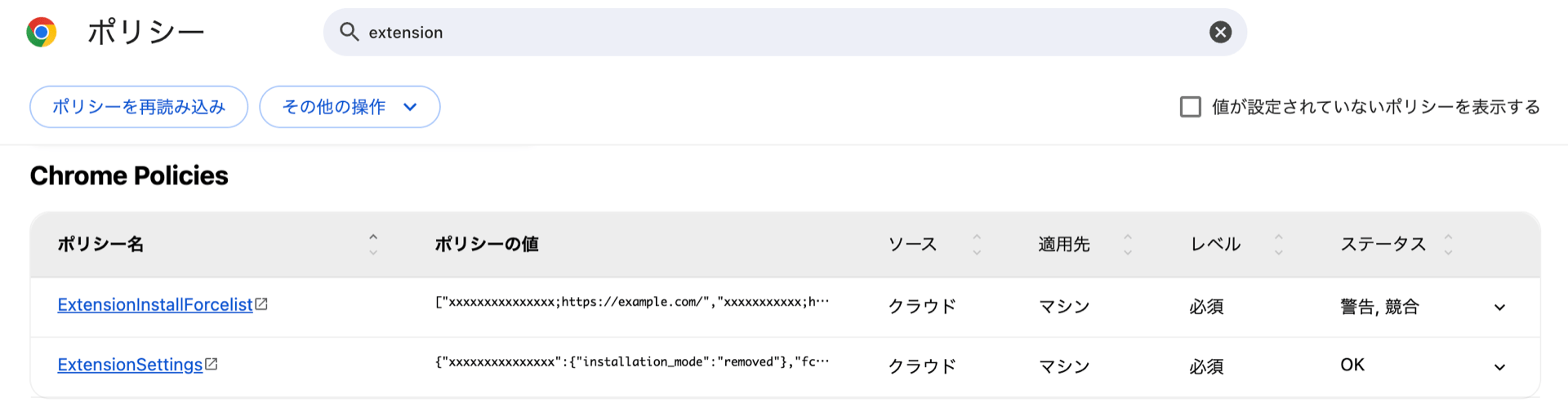
Example of chrome://policy. Each policy shows a source and an Applies to value (Japanese UI)
A cloud value is a setting that an administrator makes in the Google Admin console or a similar console. It reaches the browser directly. Among the Admina guides, the Google Workspace guide for Chrome uses this method.
When the same policy arrives from more than one source, the browser applies them in this order by default. Platform (machine) comes first, then Cloud (machine), Platform (user), and Cloud (user).
The following diagram shows which level (source and Applies to) each deployment guide in the Admina Help Center uses.

Policy precedence and the deployment methods at each level
HKLM, HKLM is the highest level, so it wins over other deployment methods. Intune writes to the device registry, so its source shows as Platform. GPO User Configuration and the Admina Intune template write to HKCU, which is Platform (user). In the Google Admin console, settings on a browser organizational unit are Cloud (machine). Settings on a user organizational unit are Cloud (user).
Policies with the same name do not merge
If two sources send a policy with the same name, by default the browser uses the whole value from the higher one. It does not combine the values. Policies with different names all take effect.
Only one value applies for the same policy name, and both apply for different names
ExtensionSettings and ExtensionInstallForcelist. If another product uses one of them, you can avoid the conflict by deploying Admina with the other.
Policies used by each deployment guide
Different guides use different policies, so be careful.Find the cause
Use the following flow to narrow down what to check and which workaround to use. The steps after the diagram explain each check.
Troubleshooting flow when the Admina extension does not install
- On the device where you want to install the extension, open
chrome://policy. Enterextensionin the search box to show only the extension policies. - Find the
ExtensionSettingsandExtensionInstallForcelistrows. - Check whether the Admina extension ID appears in the rows. If it does not, the Admina setting has not reached the device. Review the deployment steps. If that does not solve it, get the Diag data.
- If the ID appears, expand the row and check the source and the Applies to value of Value and Value (conflict). If the Admina extension ID is in Value (conflict), the Admina setting loses. If it is in Value, the Admina setting wins. In that case, another cause is possible. Get the Diag data.
- When the Admina setting loses, check the policy name of the row (
ExtensionSettingsorExtensionInstallForcelist). Both the Admina extension and the other deployment (usually asset management software) use that policy. In the Workarounds table, choose the method for that policy name.
Workarounds
Choose a workaround based on the policy name of the row where Admina loses.Values for ExtensionInstallForcelist
The deployment files from Admina (bat and ADMX) useExtensionSettings. To deploy with ExtensionInstallForcelist, set the following values with your deployment tool. In Intune, use Configure the list of force-installed apps and extensions in the settings catalog.
Software\Policies\Google\Chrome\ExtensionInstallForcelist. Add a string value (REG_SZ) to it. Name each value with a sequential number such as 1 or 2. If values already exist, use an unused number.
ExtensionInstallForcelist replaces only the force-install part. Deploy the ApiKey and other settings (under 3rdparty) as each guide describes. The 3rdparty settings are a separate policy. They still take effect even when the Admina ExtensionSettings loses to the asset management software.