

For “Directory” statuses, see User Information.
ID Types
ID types are classifications automatically assigned to accounts retrieved when an employee master is connected.
Some IDs are newly discovered through an integration with a service that is not set as an employee master. Except for IDs determined to be System IDs, these are classified by their email address:
- Email address on a company domain registered in domain settings: Unmanaged ID (status: Draft)
- Email address on any other domain: External ID
- No email address retrieved: Unknown ID
What is a Status
The following statuses represent user states: Active / Pre-hire / On Leave / Resigned / Draft / Archived / Unmonitored. When you connect an employee master, statuses are automatically assigned based on the master’s state. This includes the employment status and account enabled/disabled state.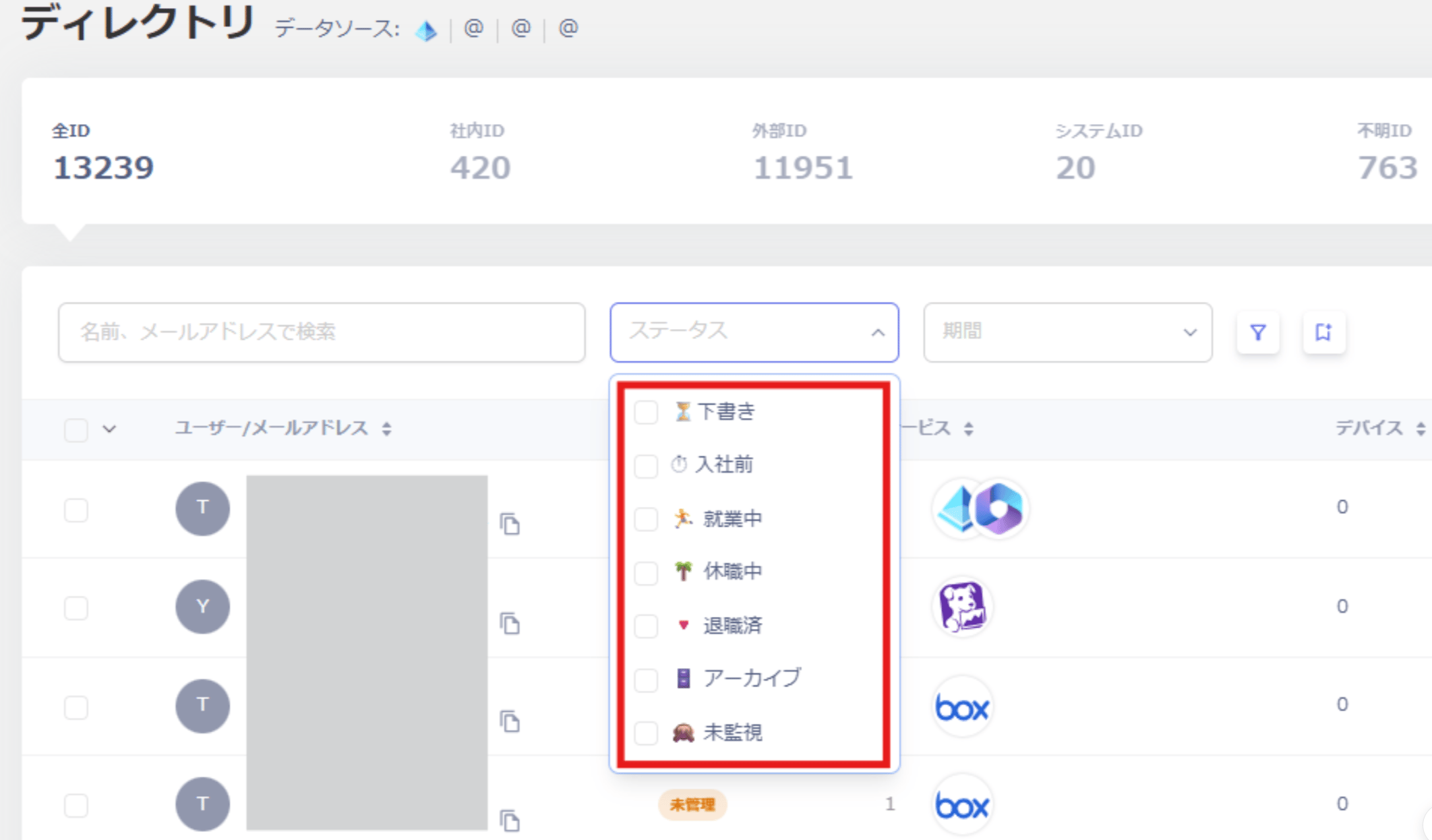
Determination Condition Details (by Service)
The following describes the ID type and status determination logic for each employee master integration.Details by Service
Google Workspace
Domain names (including subdomains and aliases) are retrieved to identify internal employees. If an email address is discovered in a SaaS app but not found in Google Workspace, we check its domain. This determines whether the address belongs to an employee.
When you delete, archive, or suspend an account in Google Workspace, its status changes at the next sync. A deleted or archived account becomes “Resigned”, and a suspended account becomes “On Leave”. The email address in the directory stays the same as before the account was deleted, archived, or suspended.
Microsoft EntraID (Azure AD), Microsoft365
Domain names (including subdomains and aliases) are retrieved to identify internal employees. However, retrieval is not possible if the tenant is different. Data from the primary tenant of the connected user is retrieved. If an email address is discovered in a SaaS app but not found in Azure AD or Microsoft 365, we check its domain. This determines whether the address belongs to an employee. Admina retrieves users in Entra ID regardless of how you registered them. For example, you can use Microsoft Entra Connect or a script. If you specify groups or a domain in the integration settings, Admina retrieves only the matching users. For details, see Microsoft Entra ID (Azure AD).
SmartHR
The sync targets are “email address accounts (User)” and “employee list (Crew)” entries. Both must have an email address registered.
If an email address account matches an employee list account, the accounts are merged as a single employee.
SmartHR Roles
Crew: Accounts present in the employee list
User: Accounts present in the email address account list
For the difference between email address accounts and employees, see What is the difference between an email address account and an employee? (external site). For data retrieved during SmartHR integration, see Data retrieved during SmartHR integration.